Space launches
Filters
Mission type: Communications | Dedicated Rideshare | Earth Science | Government/Top Secret | Human Exploration | Lunar Exploration | Navigation | Planetary Science | Resupply | Space Situational Awareness | Technology | Test Flight
Vehicle: 🗙 Ariane 62 | Ariane 64 | Ariane 64 Block 2 | Electron | Epsilon S | Falcon 9 Block 5 | Falcon Heavy | Firefly Alpha Block 2 | Gaganyaan Abort Test Booster | Gravity-2 | GSLV Mk. II | H3-22 | H3-24 | Hyperbola-3 | Launch Vehicle Mark-3 (GSLV Mk III) | Long March 10A | Long March 12A | Long March 2F/G | Mir | Miura 5 | Nebula-1 | New Glenn | Orbex Prime | PSLV XL | RFA One | Soyuz 2.1a | Soyuz 2.1b | Spectrum | SSLV | Starship V3 | Terran R | Themis Demonstrator | Unknown Launch Vehicle | Vega-C | Vulcan | Vulcan VC4L | Vulcan VC6L
Orbit: Geostationary Orbit | Geostationary Transfer Orbit | Low Earth Orbit | Lunar Orbit | Mars Orbit | Medium Earth Orbit | Polar Orbit | Suborbital | Sun-Synchronous Orbit | Unknown
Month
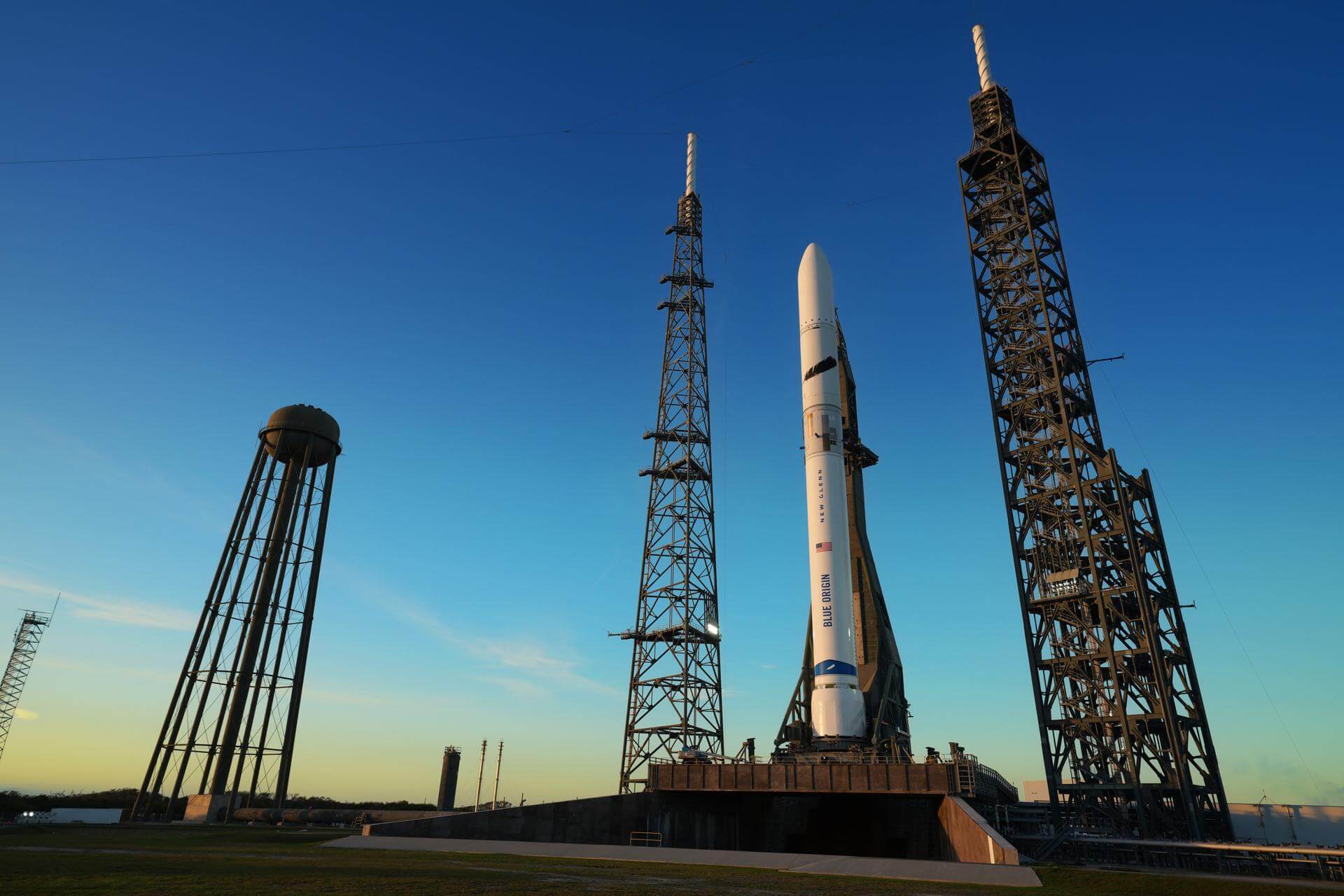
The first mission of Blue Ring, Blue Origin's all-in-one, high-powered hybrid solar electric and chemical propelled spacecraft, will test the spacecraft's operations in Geostationary Transfer Orbit (GTO), as well as subsequent operations after reaching Geostationary Orbit (GEO).
It will carry one of Scout Space's flagship next-generation space domain awareness (SDA) Owl sensors, which is designed to enhance real-time tracking, characterization, and assessment of space objects by integrating advanced optical sensing, onboard artificial intelligence-driven processing, and autonomous decision-making capabilities to deliver domain-wide intelligence in space in support of the U.S. Space Force’s space control mission set.
Blue Ring will also carry Optimum Technologies (OpTech)'s next-generation Caracal optical payload, which is designed to provide actionable insights on resident space objects and orbital activity and includes onboard image storage, object detection algorithms, and passive thermal control. The payload is designed to operate flexibly across dynamic orbits over a year-long mission profile.
Several internal Blue Origin payloads will also be hosted.
Year
Amazon Leo, formerly known as Project Kuiper, is a mega constellation of satellites in Low Earth Orbit that will offer broadband internet access, this constellation will be managed by Kuiper Systems LLC, a subsidiary of Amazon. This constellation is planned to be composed of 3,276 satellites. The satellites are projected to be placed in 98 orbital planes in three orbital layers, one at 590 km, 610 km and 630 km altitude.
48 satellites will be carried on this New Glenn launch.
Year
AST SpaceMobile’s Block 2 BlueBird satellites are designed to deliver up to 10 times the bandwidth capacity of the BlueBird Block 1 satellites, required to achieve 24/7 continuous cellular broadband service coverage in the United States, with beams designed to support a capacity of up to 40 MHz, enabling peak data transmission speeds up to 120 Mbps, supporting voice, full data and video applications. The Block 2 BlueBirds, featuring as large as 2400 square foot communications arrays, will be the largest satellites ever commercially deployed in Low Earth orbit once launched.
This launch will feature 8 satellites.