Space launches
Filters
Mission type: Communications | Dedicated Rideshare | Earth Science | Government/Top Secret | Human Exploration | Lunar Exploration | Navigation | Planetary Science | Resupply | Technology | Test Flight | Unknown
Vehicle: 🗙 Angara 1.2 | Ariane 62 | Ariane 64 | Ariane 64 Block 2 | Astra Rocket 4 | Atlas V N22 | Electron | Epsilon S | Falcon 9 Block 5 | Falcon Heavy | Firefly Alpha Block 2 | Gaganyaan Abort Test Booster | Gravity-2 | GSLV Mk. II | H3-22 | H3-24 | HANBIT-Nano | KSLV-2 Nuri | Launch Vehicle Mark-3 (GSLV Mk III) | Long March 12A | Long March 2F/G | Long March 8A | Pallas-1 | Soyuz 2.1a | Soyuz 2.1a Fregat-M | Soyuz 2.1b | Spectrum | Starship V3 | Themis Demonstrator | Vega-C | Vulcan VC4L | Vulcan VC6L
Orbit: Geostationary Orbit | Geostationary Transfer Orbit | Low Earth Orbit | Lunar Orbit | Mars Orbit | Medium Earth Orbit | Polar Orbit | Suborbital | Sun-Synchronous Orbit | Unknown
Year
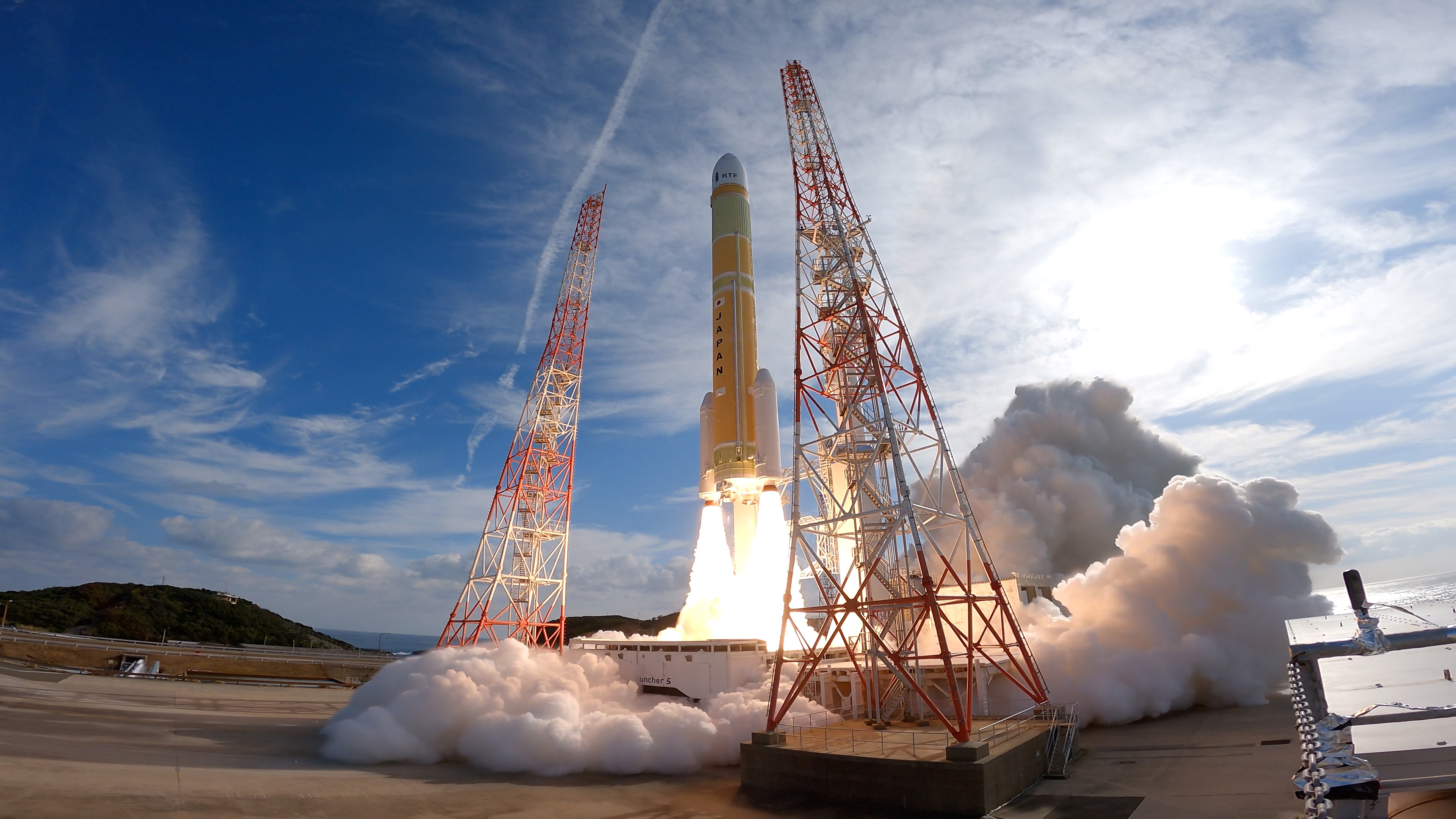
The Engineering Test Satellite 9 (ETS-9) is a JAXA project aimed to develop an advanced satellite bus, or common model, for various high-throughput satellites (HTS) for communications.
The new satellite bus by Mitsubishi Electric will focus specifically on advanced communication needs:
- Up to 25kW of power to support HTS communications
- Light mass, all-electric bus system achieved with 6kW high-power Hall thrusters (Japan-made).
- High-power Hall thrusters significantly shorten delivery of orbiting satellite compared to other manufacturer’s 4.5kW-class electric-propulsion bus systems
- The first Japanese geostationary satellite equipped with GPS receivers (Japan-made) for laborsaving autonomous orbital transfer and orbital maneuvering.