Space launches
Filters
Mission type: Communications | Dedicated Rideshare | Earth Science | Government/Top Secret | Human Exploration | Lunar Exploration | Navigation | Planetary Science | Resupply | Space Situational Awareness | Technology | Test Flight
Vehicle: 🗙 Ariane 62 | Ariane 64 | Ariane 64 Block 2 | Electron | Epsilon S | Falcon 9 Block 5 | Falcon Heavy | Firefly Alpha Block 2 | Gaganyaan Abort Test Booster | Gravity-2 | GSLV Mk. II | H3-22 | H3-24 | Hyperbola-3 | Launch Vehicle Mark-3 (GSLV Mk III) | Long March 10A | Long March 12A | Long March 2F/G | Mir | Miura 5 | Nebula-1 | New Glenn | Orbex Prime | PSLV XL | RFA One | Soyuz 2.1a | Soyuz 2.1b | Spectrum | SSLV | Starship V3 | Terran R | Themis Demonstrator | Unknown Launch Vehicle | Vega-C | Vulcan | Vulcan VC4L | Vulcan VC6L
Orbit: Geostationary Orbit | Geostationary Transfer Orbit | Low Earth Orbit | Lunar Orbit | Mars Orbit | Medium Earth Orbit | Polar Orbit | Suborbital | Sun-Synchronous Orbit | Unknown
Month
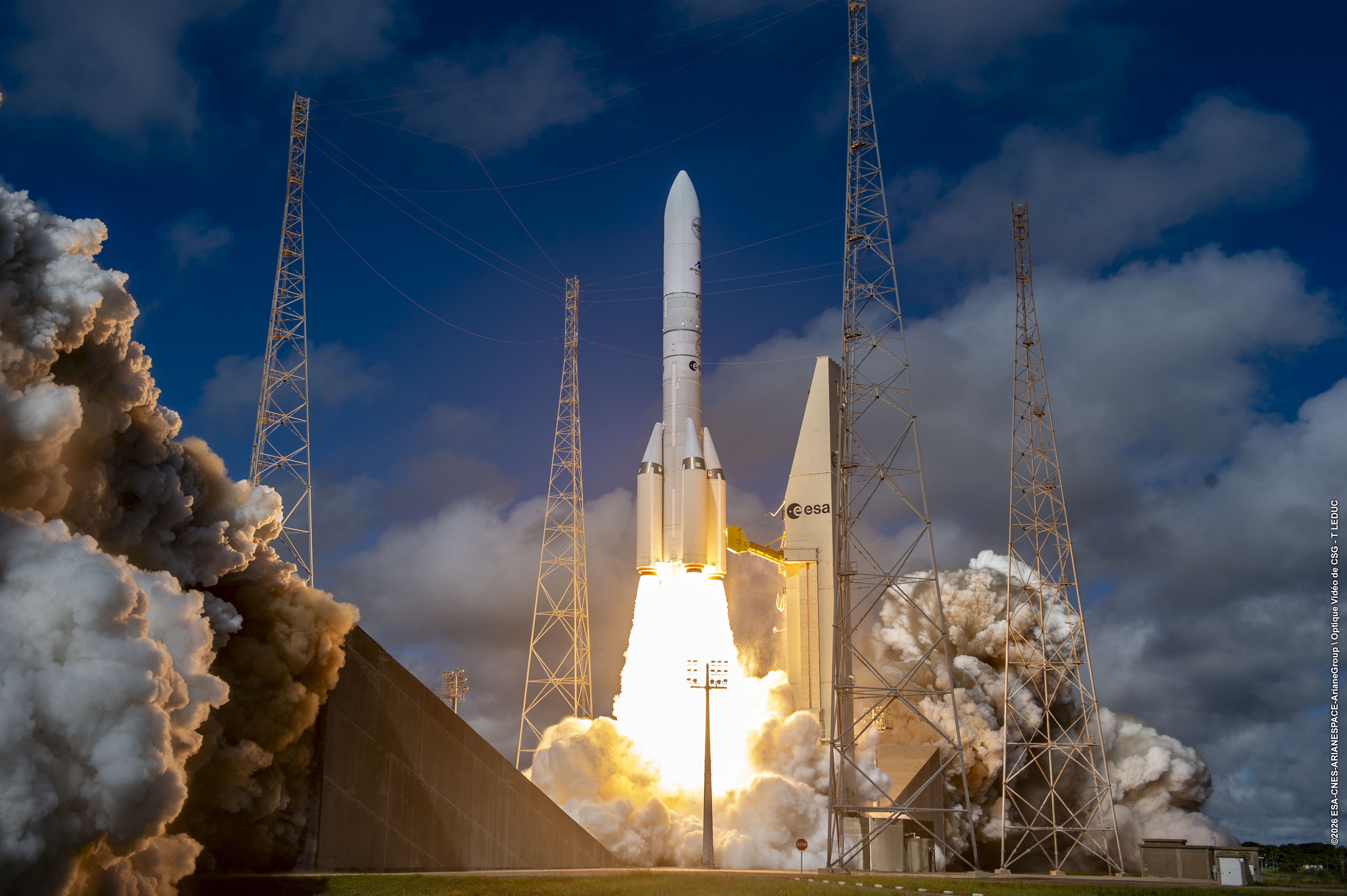
Amazon Leo, formerly known as Project Kuiper, is a mega constellation of satellites in Low Earth Orbit that will offer broadband internet access, this constellation will be managed by Kuiper Systems LLC, a subsidiary of Amazon. This constellation is planned to be composed of 3,276 satellites. The satellites are projected to be placed in 98 orbital planes in three orbital layers, one at 590 km, 610 km and 630 km altitude.
35-40 satellites will be carried on each Ariane 6 launch.